
The 1916 revolution was preceded by earlier attempts to break free from English political rule. The 1916 Proclamation notes (in the third paragraph):
“In every generation the Irish people have asserted their right to national freedom and sovereignty; six times during the past three hundred years they have asserted it in arms.”
– 1916 Irish Proclamation
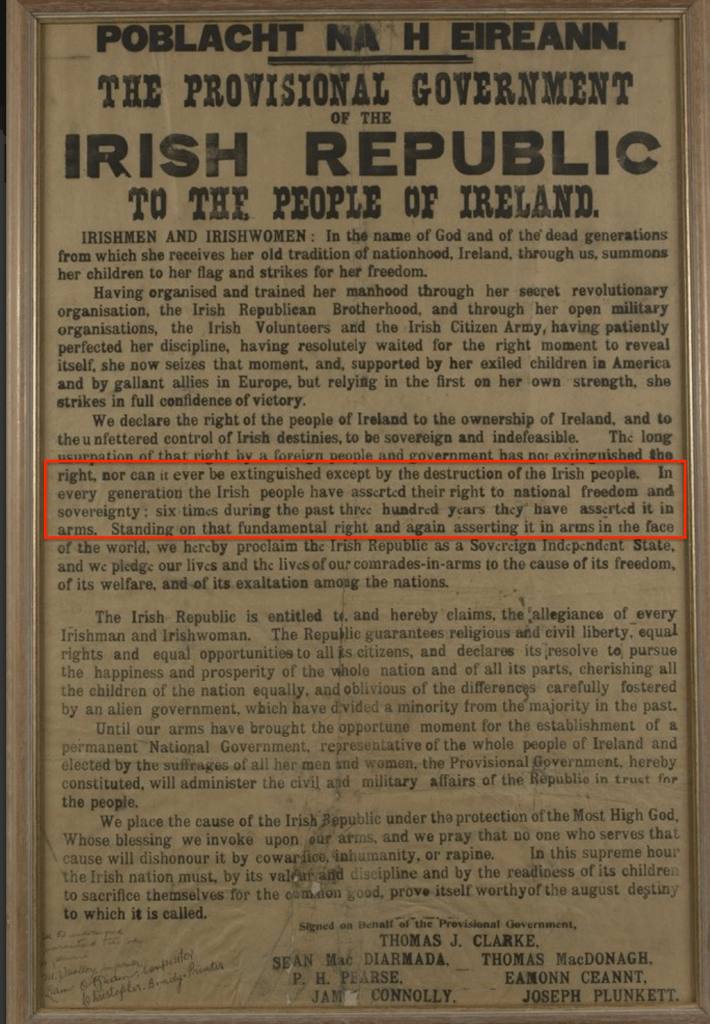
Trinity College explains that those six previous revolts occurred in
- 1641 – a revolt against the Plantation system
- 1690 – the Battle of the Boyne
- 1798 – Wolfe Tone and the United Irishmen
- 1803 – Robert Emmet and his “speech from the dock”
- 1848 – in the midst of Hunger and mass emigration, the Fenian movement is born
- 1867 – the Fenians rebel with help from abroad including the U.S.
I have briefly reviewed each of these events below using photos from our trip. I wanted to solidify this history for myself but also for Arjun. This is a great example of how a family vacation can double as an informing field trip about heritage and history. I knew none of this history before our trip but I am so glad. to learn the nuance and better understand Ireland’s history. This overview is basic and meant to capture the broad brushstrokes; so much detail abounds, which can be explored as well but with this post as a basic foundation.
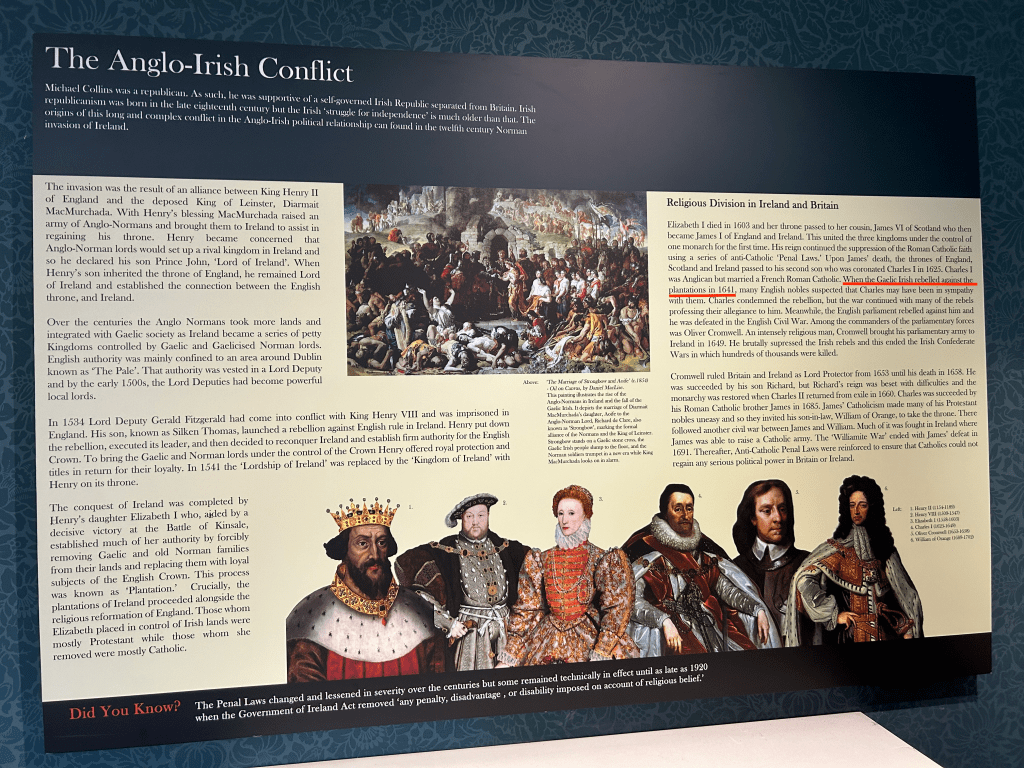
Revolt #1 – 1641 & the Cromwellian Conquest
This was a revolt against the “plantation” system in Ireland. What follows from 1649 to 1653 is Oliver Cromwell’s campaign to forcibly take large swaths of Irish land. “Penal laws” are then enacted to deny Catholics the ability to gain political power in Ireland.
Revolt #2 -1690 & the Battle of the Boyne
The year 1690 saw the Battle of the Boyne, part of larger geopolitical conflict involving England and France and Catholic and the Nine Years War which was a “European alliance against French expansion.”
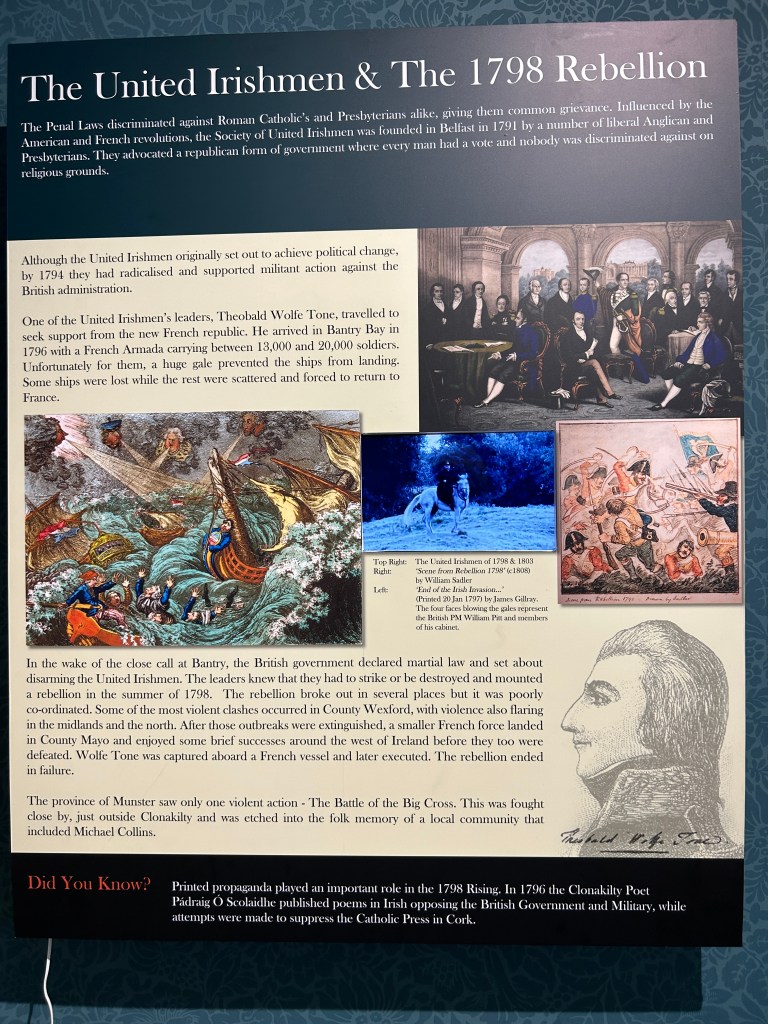
Revolt #3: 1798. Wolfe Tone and the United Irishmen
In 1791, Theobald Wolfe Tone (1763-1798) helped found the Society of United Irishmen. Wolfe Tone helped lead a revolt in Ireland in 1798 with help from a French military force. The recent American and French revolutions were inspirational to the United Irishmen. The Museum of the American Revolution in Philadelphia has an excellent online exhibit about the United Irishmen here.
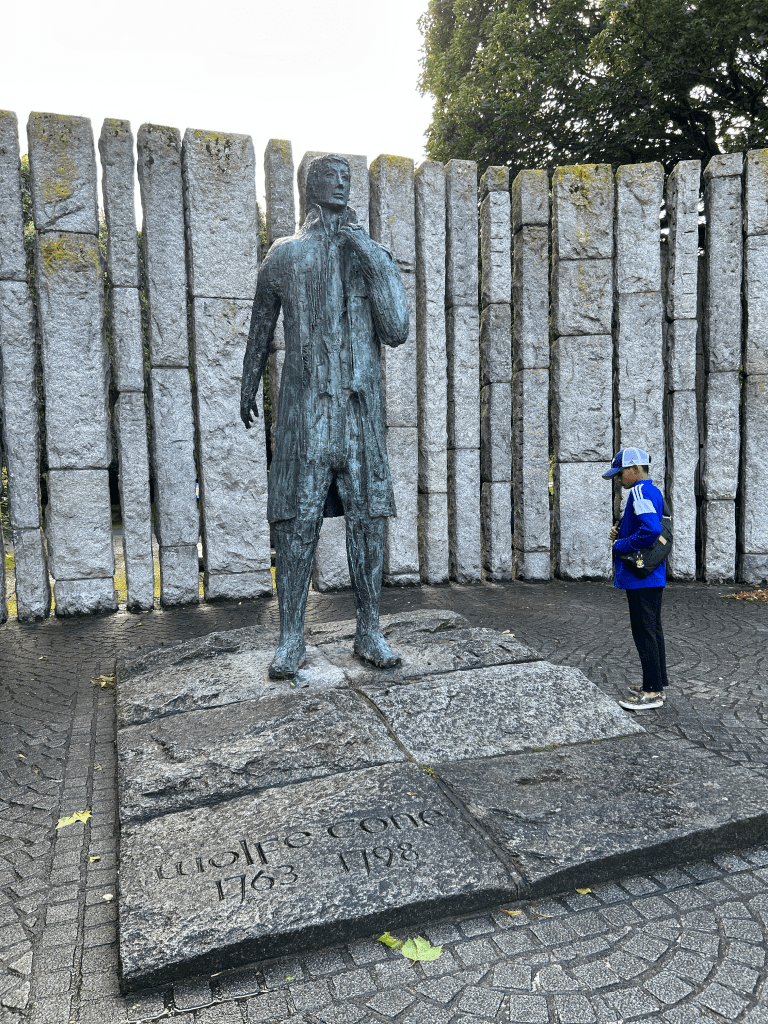
While in Dublin, we happened to pass by an incredible statue dedicated to Wolfe Tone. I clicked a picture of Arjun next to it; I love how big this statue is, as it symbolizes Wolfe Tone’s importance to the years and rebellion efforts that would follow. Interestingly, the book “James Connolly” by Lorkin Collins recounts how this statue, located at the northeast corner of St. Stephen’s Greene, was dedicated in 1898 during the 100-year centennial of that year’s revolt (page 74). It’s an interesting, explicit example of how the rebellions echoed through time, impacting future leaders.
Another interesting note, this one from County Cork, was “The Battle of the Big Cross” which was close to where Michael Collins grew up in Clonakilty. We visited the Michael Collins House which is maintained by Irelands OPW, and that exhibit made note of the likely impact of The Battle of the Big Cross on a young Michael Collins and others growing up in early 20th century County Cork.
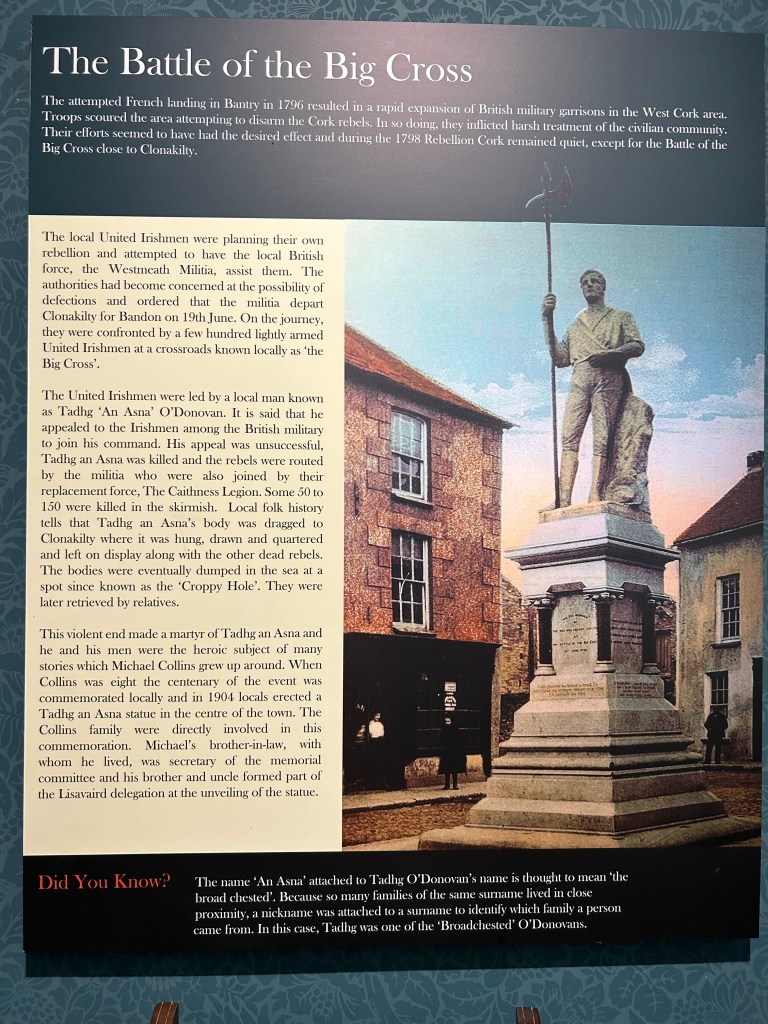
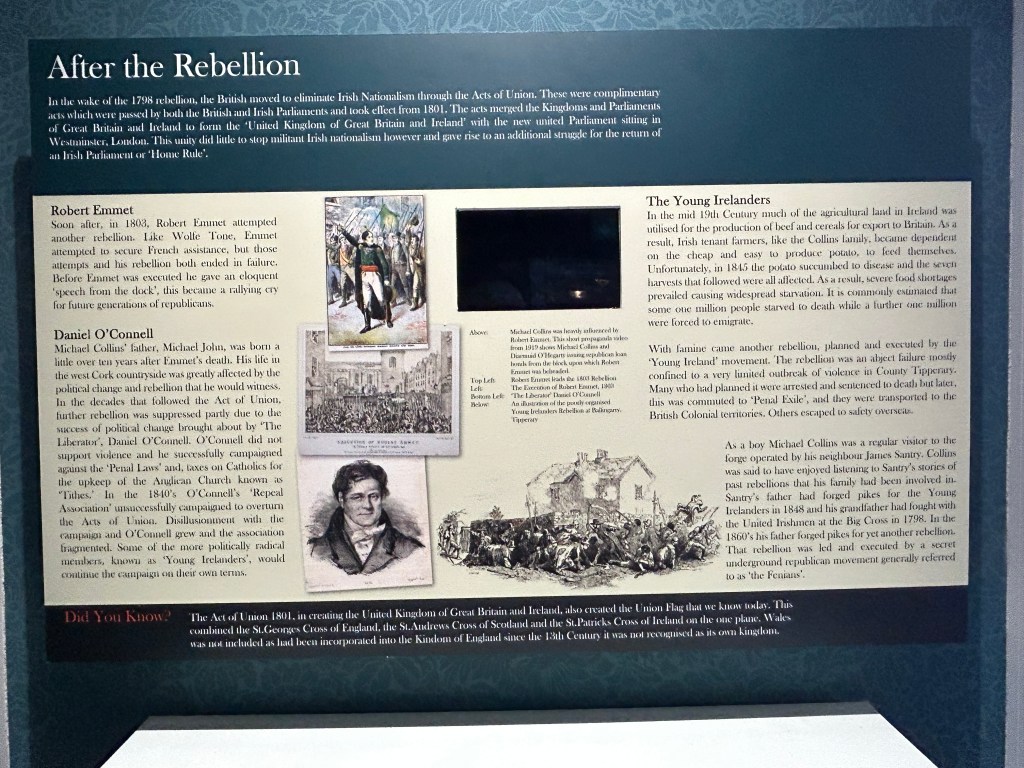
In 1801, in direct response to the 1798 revolt, England “persuaded the Irish Parliament to pass the 1800 Act of Union, effectively voting itself out of existence.”
Revolt #4: 1803 – the Martyrdom of Robert Emmet
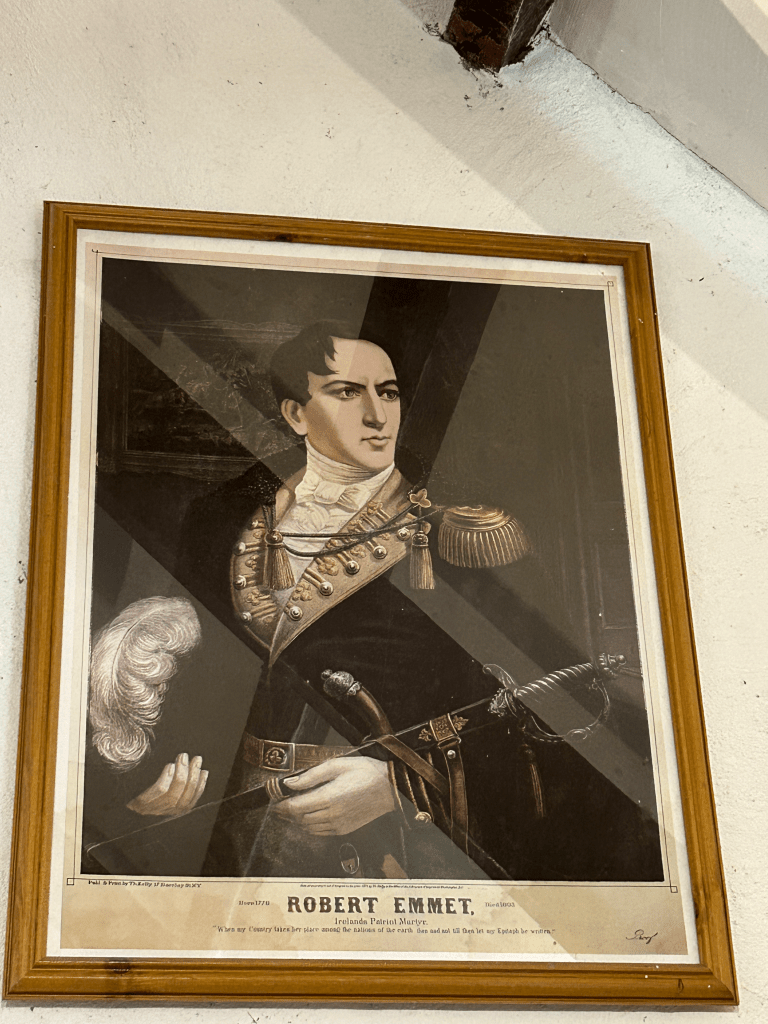
We learned about Robert Emmet (1778-1803) while on the 1916 Rebellion Walking Tour with Lorkin Collins and he took us to our only sighting of Dublin Castle. Emmet was part of a failed 1803 revolt that resulted in his execution. He was “hung and beheaded,” a particularly awful death that involved strangulation via the noose followed by the actual beheading. Lorkin made note of how impactful Emmet was, including his famous “speech from the dock.” I was curious about this speech and found an interesting article about the speech that noted:
“Robert Emmet was a fiery young hothead of twenty-four when his wild scheme for an Irish rebellion collapsed into a street fracas one July day in 1803. Arrested while taking leave of his beloved before making good his escape, he was brought to trial on September 19th and executed the following day. His inglorious failure might well have passed into oblivion but for his speech from the dock after sentence had been passed. This has become one of the great set-pieces of Irish olitical rhetoric. The final sentences, as now usually recorded, were ‘when my country takes her place among the nations of the earth, then, and not till then, let my epitaph be written..“
– Text and Tradition: Robert Emmet’s Speech from the Dock, Studies: An Irish Quarterly Review, Vol. 71, No. 282 (Summer, 1982), pp. 185-191 (7 pages)
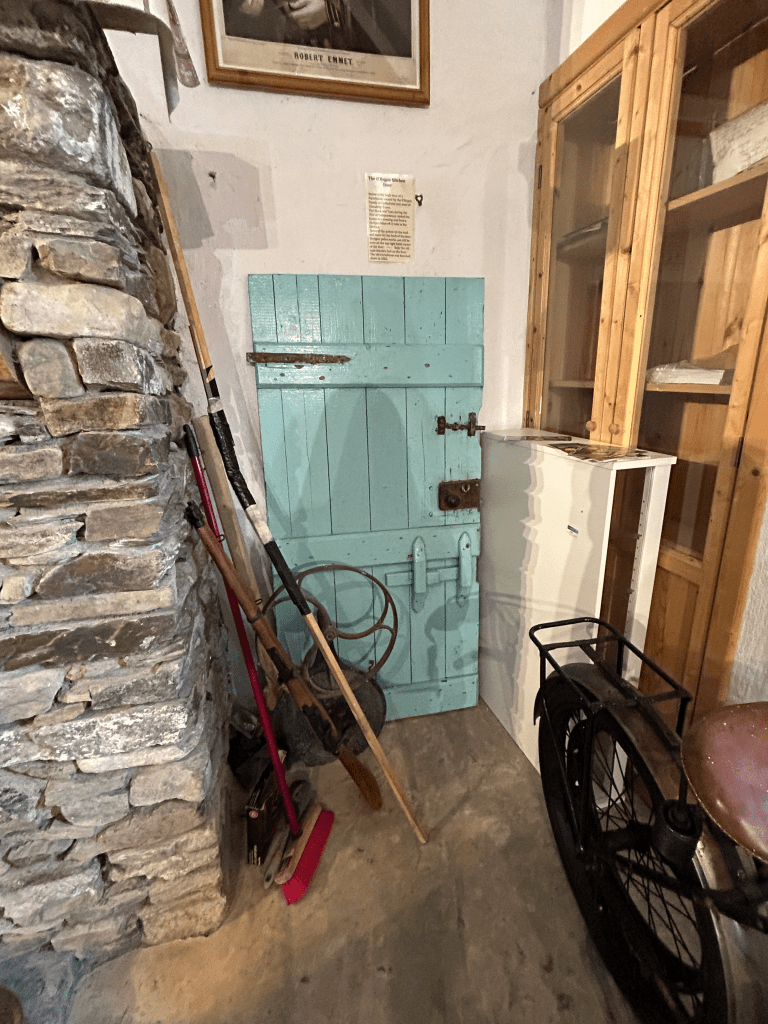
While on a tour of the Michael Collins Centre in Cork County, I clicked a picture of Emmet that was hanging on the wall:
Interestingly, there is a statue of Robert Emmet in Washington, D.C. at 24th and Massachusetts Avenue, something to check out if in the nation’s capital:

Daniel O’Connell and political gains for Catholics in the 1840s.
We learned about Daniel O’Connell, called “the Liberator” for his political gains earned for Catholics, throughout our trip. He is the founder of Glasnevin Cemetery which was formed to be a home for all in Ireland, regardless of background or creed. The O’Connell Tower dominates the cemetery and is the tallest round tower in Europe. Arjun and I climbed it to the top – 198 steps – and quickly descended back down as it was quite crowded at the tippy-top. We also visited O’Connell Memorial Church while on the Ring of Kerry; it is located in the town of Cahersiveen, County Kerry. O’Connell is also etched into the Dublin map, connecting Parnell Street to the north down to the O’Connell Monument and O’Connell Bridge which crosses the River Liffey.
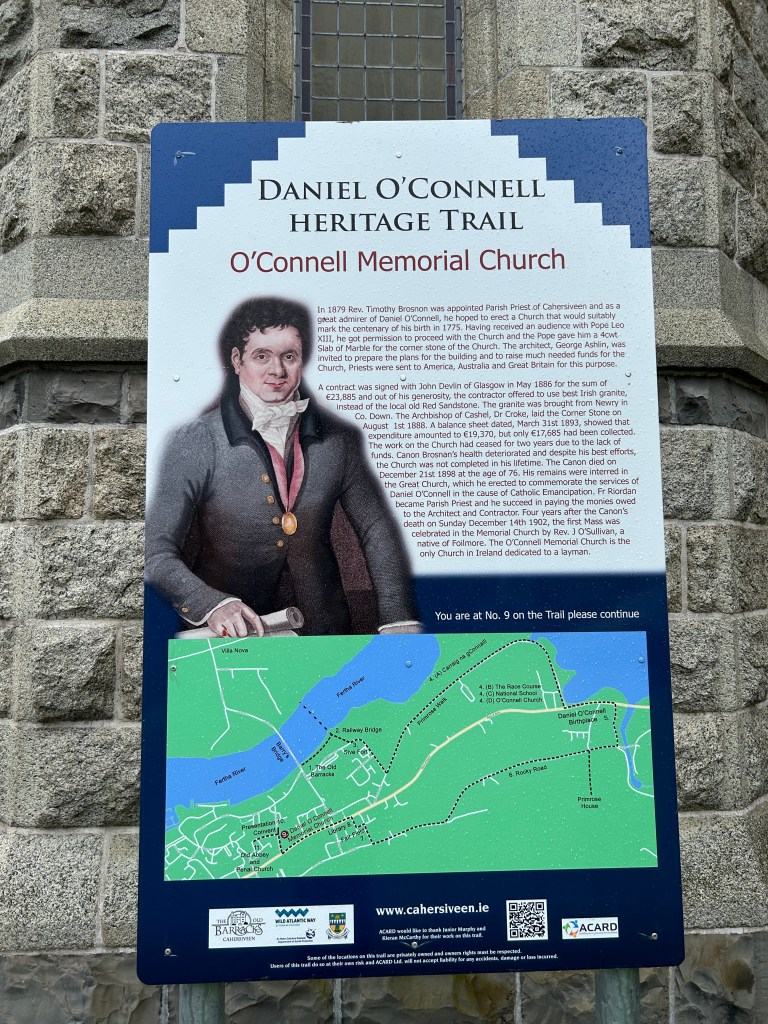
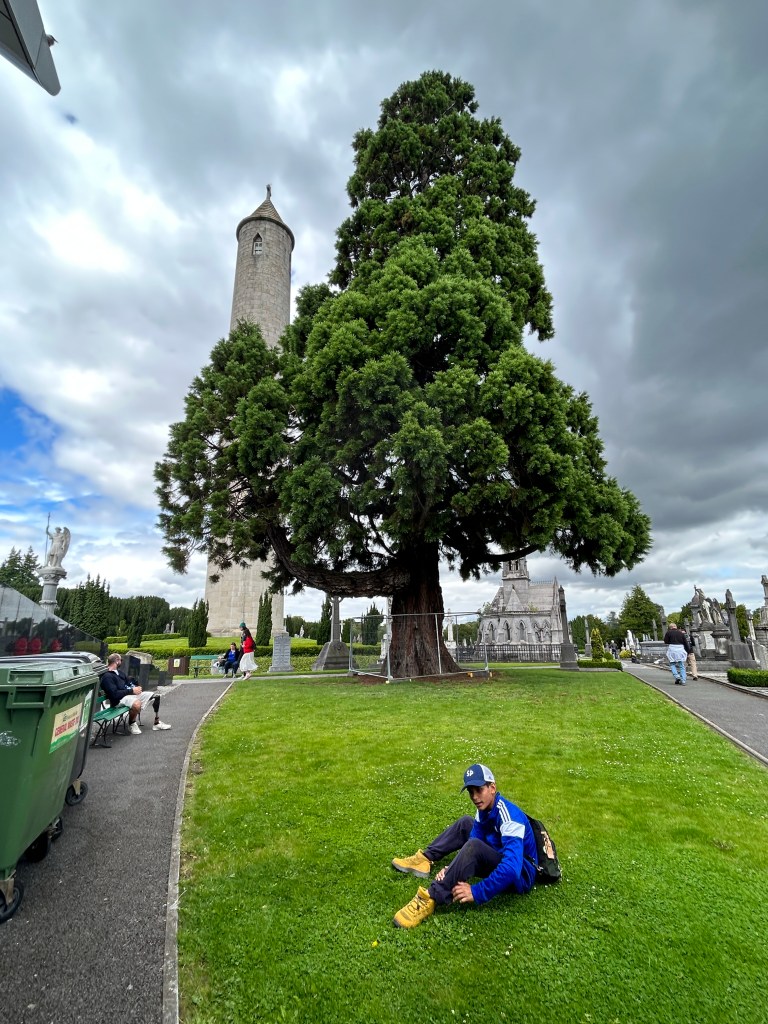
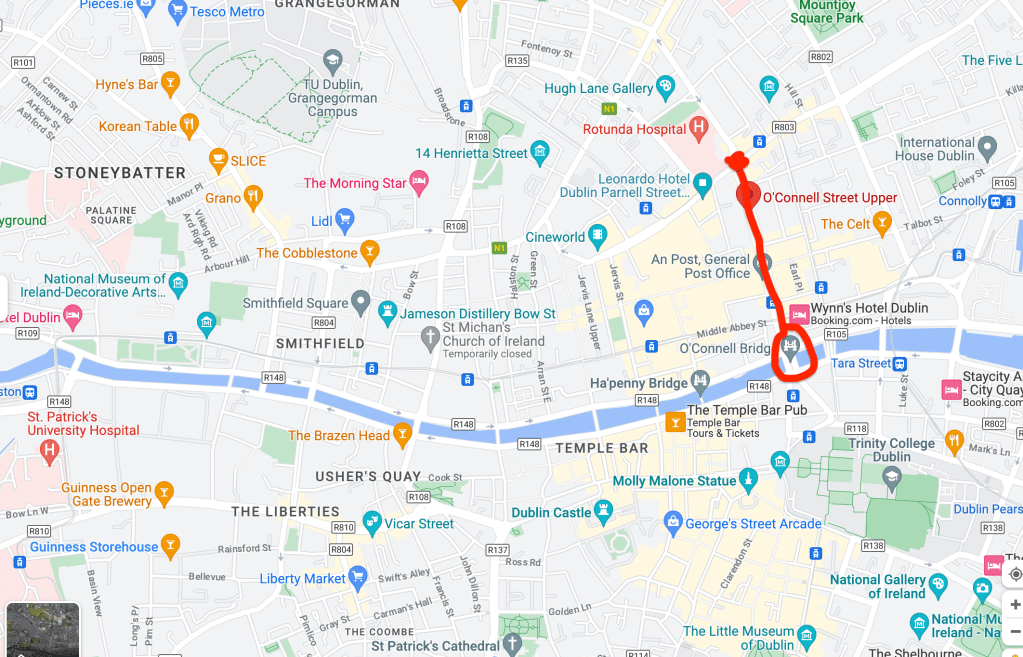
O’Connell was notably a pacifist. He was a member of the United Irishmen but had not joined the 1798 Rebellion. He arguably had other means to fight for the cause, having access to education and thus political agency. He was educated in London as a lawyer and later was admitted to the Irish bar. He helped gain greater freedoms for Catholics with the Catholic Emancipation Act of 1829 and then served in Parliament, which by that point was located in London’s Westminster.
Revolts #5 (1848) and #6 (1867): the Young Islanders and the Irish Republican Brotherhood
By 1848 Ireland was racked by the Great Hunger which led to mass emigration out of Ireland, including to the United States. The 1840s see
I found an interesting paper that explains this period as “pivotal” given its role in the formation of the Fenians and the through-line to the 1916 Rising.
“…while Wolfe Tone and Emmet may have been inspirational, it was the experiences in politics and developments in political theory stemming from the 1840s Young Ireland movement that had the greatest impact. Though the 1848 rebellion led by William Smith O’Brien has often been derided by historians, it was a pivotal event which led directly to the foundation of Fenianism, which in turn led directly to the Land League revolution 1879-82 and indeed the 1916 Rising. The influence of James Fintan Lalor is highlighted as it was Lalor who came up an alternative formula to constitutional agitation arguing that England’s treatment of Ireland had given the Irish a moral right to a legal tabula rasa over both land ownership and constitutional claims.”
– Young Ireland and Irish Revolutions, Frank Rynne, p 105-124
Interestingly from a Jersey City perspective, the paper also notes that:
“On St Patrick’s Day 1858, Stephens, Thomas Clarke Luby and Joseph Denieffe founded the Irish Revolutionary, later Irish Republican Brotherhood.”
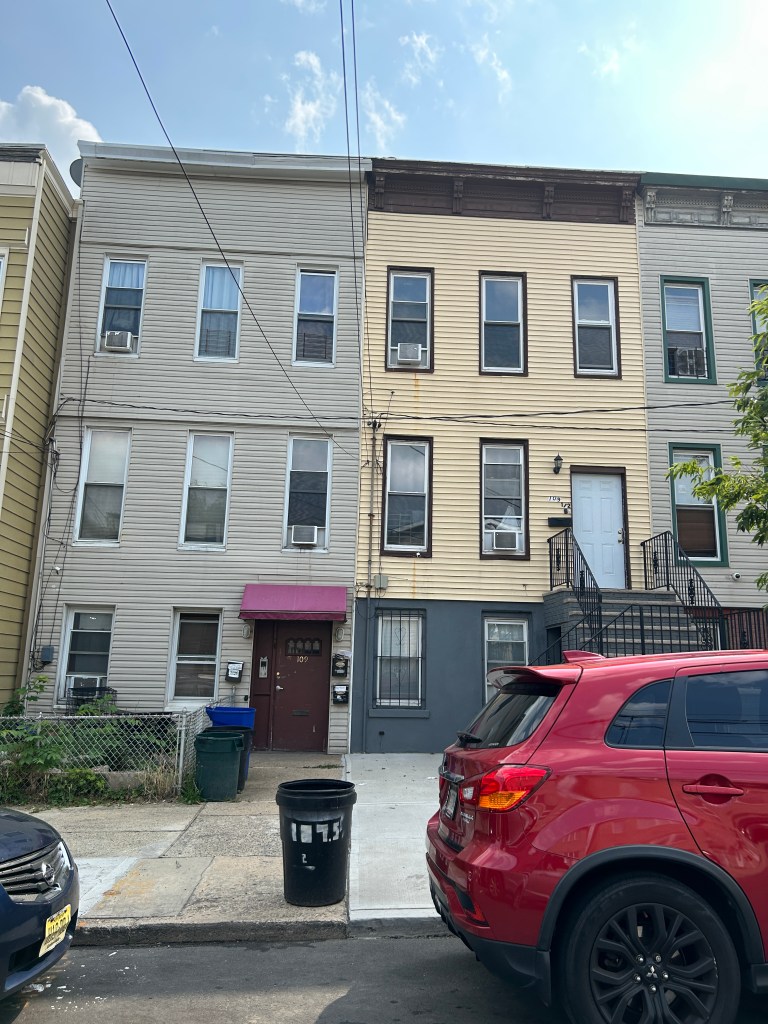
Luby had emigrated to Jersey City where he died at 109 1/2 Oake Street (in what is now Greenville) and is buried in Bayview Cemetery, not far from our home.
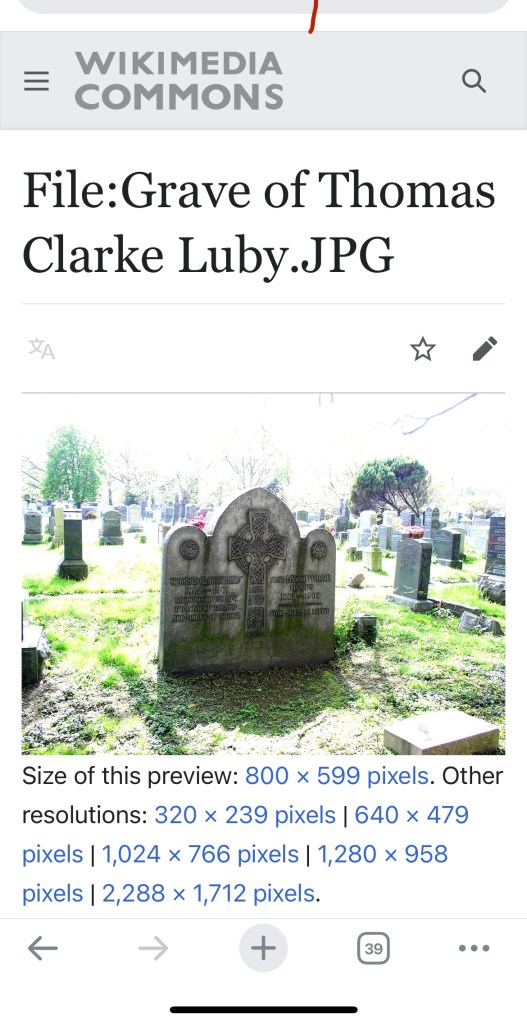
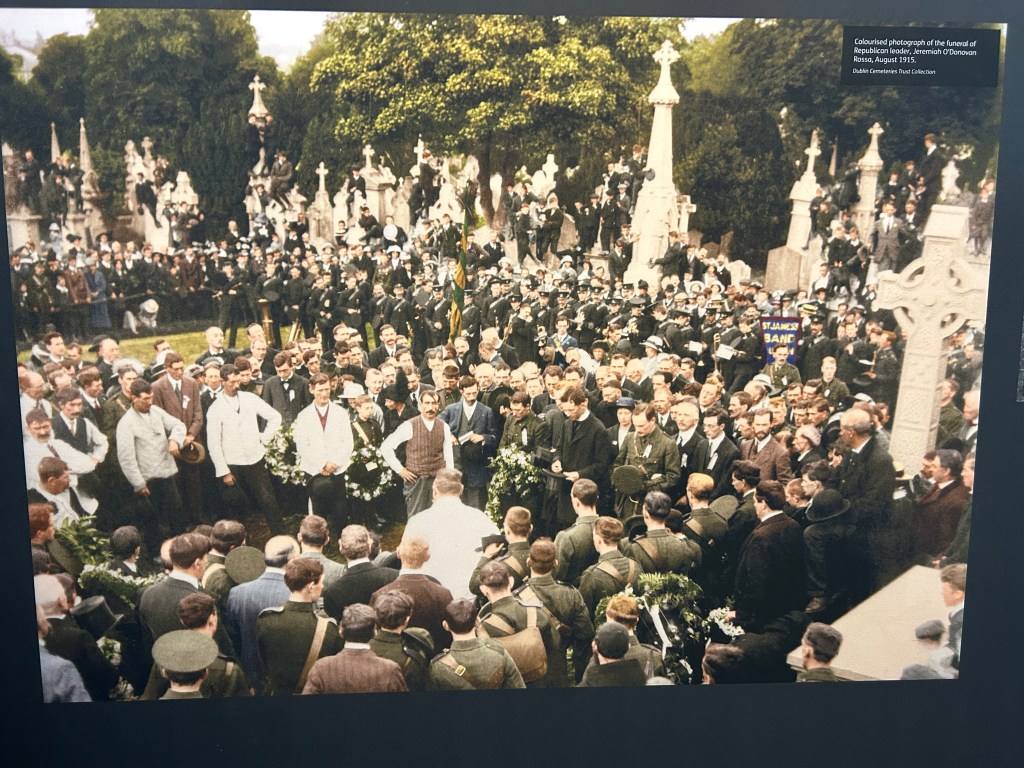
It was during this time that Jeremiah O’Donovan Rossa, a Fenian leader alongside Luby, was imprisoned and eventually forced to emigrate, ultimately landing in the United States. He would, as it was explained to us on the Glasnevin tour, work from Staten Island to raise funds for the IRB from abroad to support an 1867 uprising but it was crushed easily. O’Donovan Rossa would, however, play a final pivotal role upon his death, much later, in 1915; his body was sent home to Glasnevin for burial midway on August 6th, attended by thousands of mourners. That funeral was used as an organized event to catalyze support by the leaders of the next and last revolt, the 1916 Easter Rising. Each day at 2:30pm, a re-enactment is performed at Glasnevin of Patrick Pearse’s oration at O’Donovan Rossa’s funeral. The oration would prove to have similar last power and emotional punch as Robert Emmet’s speech on the dock, another echo through time. A funeral captures the funeral and several leaders of the 1916 Rising including Thomas Clarke and Patrick Pearse.
We watched the daily re-enactment on August 1st, 2023 — 108 years to the day after the actual event.

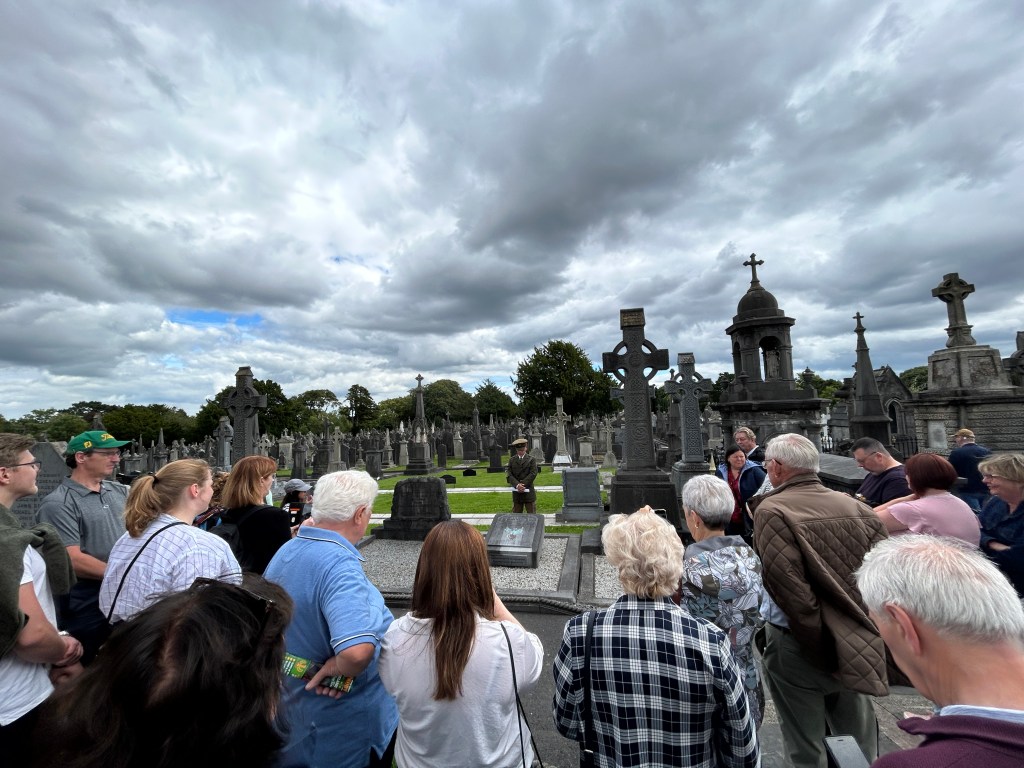
I was most moved to learn of Parnell’s grave. Charles Stuart Parnell rose to political prominence and power in the 1870s as an advocate for Home Rule, which argued for Irish self-rule, i.e. remaining within. the United Kingdom but having political power re-anchored within Ireland. Parnell was a wealthy Protestant land owner with political power and very popular with the people. Upon his death, he was buried at Glasnevin “in the former poor ground, on a mound erected over the site of a cholera grave of 1849, reflecting Parnell’s wish to be buried with ‘the common men and women of Ireland’.” The grave marker is a simple large stone with his name engraved on it.

Reflections
I’m struck by how each of these revolts reverberated for future generations. Emmet’s speech on the dock had similar oratory power as Pearse’s oration at the O’Donovan Rossa funeral. Martyrdom fueled future movements which inspired new leaders who also became martyrs for the cause of Irish freedom. And the Great Hunger, which sparked mass emigration and is such a well known event of epic horror, created new avenues of support from abroad. There is so much interesting, layered, and meaningful history here that is worth exploring more.
 My Notebook